Showing posts with label Pennsylvania. Show all posts

Friday, July 21, 2017

DEMOCRATIC ECONOMIC INITIATIVES AND THE TRUMP BASE

I've tried to think of ways that the Democratic Party might lure back the white male worker.  After considerable thought, I conclude there probably isn't a way.  Just consider our previous President, Barak Obama.  There was the Birther Movement among Republicans that Obama wasn't born in the U,S.  Even when he finally released the "long form" of his birth certificate the doubters said it was a forgery.  There was nothing you could do to get them to admit Obama was born in the U.S. to an American mother.  Even as recently as August of 2016 before the election as many as 72% of Republicans felt that Obama was not legitimate.  This percentage is far more than President Trump's base.

These same people, however, were ready to accept Senator Ted Cruse as legitimate even though he was born in Canada because he had an American mother.  So by analogy even if Obama was born outside America, it was to an American mother so if Cruz is legitimate, Obama should be also, but a double standard is clear.

The problem is that these workers feel the Democratic Party favors women, minorities, and Gays.  So the Democratic Party would have to abandon these groups.  Yet it was probably enough women, minorities, and Gays who crossed over and voted for Trump to put him over the top in crucial states because they felt that the Democratic Party hadn't done enough for them.  Politics is a hard game.

Still, the Republican Party is not a good fit for the disaffected white male workers.  For one thing, the Republican establishment ("elites") feel American workers are overpaid, and I feel the workers are also held in disdain by the establishment.  Even Donald Trump has said on at least two occasions that the American worker is overpaid.  For years, however, the Republican establishment soothed the white American male worker through telling them such things as they are "The Real Americans" and other syrupy terms.

But along came a candidate for President who talked in their terms.  Send illegal Hispanics back to Mexico, build a wall, outlaw Muslim immigration to the U.S., and "keep THEM under control."  The "Them" is, of course, women, minorities, and Gays.  They thought Trump would lead them "out of the wilderness" in a reform of the Republican Party, but they were conned.  I've heard from some of Trump's base say that the wall is the big thing (even over better pay), so it is the emotional things they love.

Below I've noted some of Hillary Clinton's proposals and actions (Quotes from references are given in italics):
Increase The Minimum Wage
    If the minimum wage is increased, everybody above it gets a raise also.
    She supported a $12/hr minimum wage.  She supports prevailing wage laws in states and a $15/hr  minimum wage where economics support it.
  • Every student should have the option to graduate from a public college or university in their state without taking on any student debt. By 2021, families with income up to $125,000 will pay no tuition at in-state four-year public colleges and universities. And from the beginning, every student from a family making $85,000 a year or less will be able to go to an in-state four-year public college or university without paying tuition.*
  • All community colleges will offer free tuition.*
Work for Women's Equality**
"If fighting for women’s health care and paid family leave and equal pay is playing the woman card, then deal me in."

She began her career at the Children's Defense Fund.  Wrote a book "It Takes A Village To Raise A Child," and fought to pass the Children's Health Insurance Act that has covered an estimated 8 million children.  Perhaps a negative was that she cosponsored the "Dream Act" three times.

And if there was any state the "owed" Hillary Clinton their vote it was Michigan.  She voted to save the automobile industry and Michigan has had the best record of increasing employment of the "rust belt" states.  She also was early involved in the Flint, Michigan, water problem.***

While Clinton may not have put a ton of resources into Wisconsin, her campaign peppered Michigan with visits by her and her surrogates during the final weeks.
Still, in Detroit, she won roughly 50,000 fewer votes than Obama did in 2012.***
She also campaigned in Detroit.****  I have no idea what more she could have done.

I think a problem for the white male worker is that Hillary is a woman.  This also seemed to bother many white educated women, especially in Pennsylvania where she had a major effort.  Incidentally, Pennsylvania is the Rust Belt state that had the greatest wage increases although the employment picture was static.

It seems like there is nothing the Democratic Party can do to win over the Trump base.

What all this means is that Congress is probably going to have to impeach the President (or Department heads rule he is incompetent: 25th amendment) while Republicans voters vastly approve of him (They will say he wasn't given a chance though Trump hung himself.).  This is going to take time.  You can find any number of Republicans outside of Congress, however, that oppose Trump vehemently.

* https://www.hillaryclinton.com/issues/
**  http://www.refinery29.com/2016/08/118582/hillary-clinton-strong-women-quotes
*** http://www.salon.com/2016/01/21/what_hillary_clinton_needs_to_learn_from_the_flint_water_crisis/
http://www.freep.com/story/news/politics/2016/11/09/how-clinton-lost-blue-wall-states-michigan-pennsylvania-wisconsin/93572020/
**** https://www.c-span.org/video/?416681-1/hillary-clinton-campaigns-detroit-michigan
https://www.c-span.org/video/?418008-1/hillary-clinton-campaigns-detroit-michigan


Monday, December 5, 2016

GREAT RECESSION VERSUS THE GREAT DEPRESSION - II

Part I of the comparison between the Great Recession versus the Great Depression dealt with the emotional after effects of a financial collapse for a country like the U.S.  Herein I will only discuss the economic effects of the Great Recession on labor wages in the Upper Midwest.  This region is often called the Rust Belt, a term that became popular back in the 1980s.  So the labor problems of the Rust Belt have been around for a long time and have little to do with the Great Recession.  Nonetheless, the angry "white" Midwestern workers came to a boil in the recent election.  So why now?

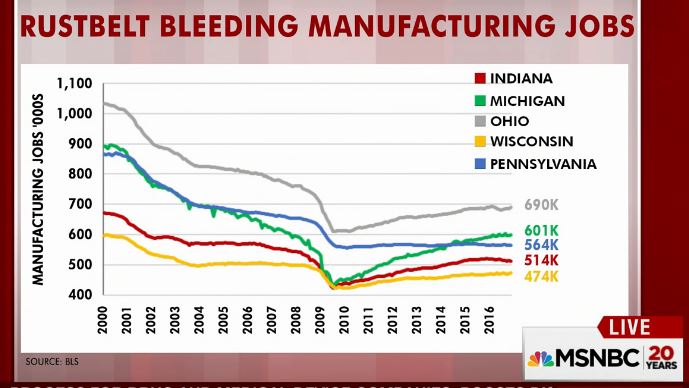
 Every so often on Morning Joe, they have Steve Rattner give the status of some economic condition.  I thought Rattner presented two very compelling charts on the December 1, 2016 show that I have captured related to some of the angry feelings in the Midwest towards government.  Of course one should notice in the figure that the steep decline in Rust Belt manufacturing jobs started well before the Great Recession, mostly during the administration of George W. Bush, with a particularly steep drop ("waterfall") going into the Great Recession.   Such improvement as there has been was during the administration of Barack Obama.  Note that with the Obama administration the decline in manufacturing workforce has stopped and has even started a slow recovery in all the states except Pennsylvania.  You would think that workers would be happy that the decline (the bleeding so to speak) has not only stopped, but actually has slowly reversed in most states.  However, we  are told they aren't happy at all, so the reason for their anger must be sought elsewhere, such as the emotional effects of the Great Recession (see Part 1).  but before we get too hysterical about this, please recall that Trump won these states by very small margins Michigan by less than 11,000 votes out of more than 4.8 million votes cast and Wisconsin by 27,200 out of 2.9 million votes cast and for Pennsylvania won by 46,530 votes out of nearly 6.9 million votes cast.), so maybe many people were grateful for the progress after all.

Below is some of the text of Rattner's presentation (in italics):

(Click on figure to enlarge)

The role that white working class voters played in Trump’s election is now widely accepted; this chart provides graphic back up for how tough it has been for these workers over nearly two decades and how minimal the much vaunted renaissance of manufacturing has been. ...  Pennsylvania, once the home of the steel industry, has had no recovery in manufacturing jobs since the financial crisis.
Only Michigan – thanks to the success of the auto industry – has shown a meaningful rebound in manufacturing jobs and even Michigan’s total is still just two-thirds of what it was at the peak.
It’s important to recognize that not all these job losses are due to trade or globalization; improving efficiency also played a role in the lower need for workers (although those productivity gains have been minimal in the last several years.)*

(Click on figure to enlarge)

Note in the above figure, that although jobs have had a rebound in Michigan, the decline in wages that started long before the Great Recession has continued since, though at a slower pace.  One can see some cause for anger there.  Something like "It is nice to see my friends get back to work, but not at the expense of my wages."

In contrast,  although Pennsylvania has not seen a rise in manufacturing employment, those remaining have seen the largest increase in wages of the five states and actually are even back to 2003 levels.  One might wonder why manufacturing workers in Pennsylvania are so angry as the current workforce has bounced back in wages.

Certainly a part of the problem for the slow wage recovery was lack of a meaningful infrastructure program as construction (among other occupations) was very hard hit by the Great Recession.

Steve Ratner continues:

While attention mostly is focused on jobs, it’s important to recognize that falling wages are also a problem – and nothing in Trump’s announcement will address that problem, which is directly a result of trade and globalization, not automation [Emphasis added.  See comment below]. In this category, Michigan – again because of the strong presence of the auto industry – has been the hardest hit, with average hourly wages in manufacturing falling from $28 per hour in 2003 to just over $20 per hour at present. (These numbers are all adjusted for inflation.)*

Though I have great appreciation for him, Rattner is certainly wrong that automation has had nothing to do with the decline of wages by workers.  The wages actually must be below the costs of automation as well as achieve some sort of parity with the wages of the lowest cost countries.**  Low wages in many countries, however, are tempered by the costs of shipping and some other factors like the generally higher price of natural gas in foreign countries.  Thus the cost of selling something in the US. made in China may be more equivalent to, let's say, $8/hr  (as a guess) rather than the $4/hr cost of labor in China, still a large difference.

I get the feeling that the manufacturing worker has been thrashing around for some years, trying to seek a political solution to the decline in manufacturing in the Rust Belt.  In 2008, these people not only changed the "coach" (the president) but also the "team"  (the Senate and two years earlier the House).  Now in 2016, they changed the coach again, but left the team essentially in place.  We should remember that the President-elect won these Rust Belt states by very small margins, suggestiong to me a high level of confusion.  In the 2016 election they actually chose a n"coach" who was in confilct, not only with most of the Democratic Party but the Republican Party establishment as well but left the "team" essentially in place.  We will see how that works out.


(Click on figure to enlarge)

Adding to their problems is that the American worker has been convinced to disarm and abandon unions.  The decline in wages has paralleled the decline in unions.***   While unions may not be very effective, they are workers only hope in dealing with management.

* http://stevenrattner.com/2016/12/morning-joe-charts-putting-trumps-carrier-deal-in-context/
** http://stopcontinentaldrift.blogspot.com/2014/05/plight-of-american-workers.html
*** http://stopcontinentaldrift.blogspot.com/2013/10/a-race-to-bottom.html

Sunday, November 20, 2016

STATE JOBLESS RATE CHANGE (OCTOBER 2015 AND OCTOBER 2016)

The WSJ has an article that discussed states with rising and lowering unemployment with regard to the recent presidential election.  I found the information to be interresting regardless of the election and quote a few passages here (in italics).  You of course will want to look at the original article that include a table where you can scroll down and see your own state (information for the states comes from the Labor Department).

Unemployment rates in October ranged from a low of 2.8% in South Dakota and New Hampshire to 6.8% in Alaska.
..................................................................
[There were]17 states where unemployment rose over the past 12 months
..................................................................
 ... Pennsylvania ...  saw its unemployment rate rise from 4.8% in October 2015 to 5.8% in October 2016. 

There were 33 states with falling unemployment over the last year:
...states with falling unemployment, such as North Carolina  [5.6% to 4.9%] and Michigan [5,1% to 4.7%], whose rates dropped by 0.7 and 0.4 percentage points respectively over the year. ...  And Wisconsin, ...  saw its unemployment rate drop to 4.1% in October 2016 from 4.6% a year earlier. But falling unemployment doesn’t necessarily translate into good jobs or jobs for everyone. For the first time in 2016, the bulk of the U.S. labor force wa college graduates.

Results for some states:
(Click on figure to enlarge)

http://blogs.wsj.com/economics/2016/11/18/states-with-rising-unemployment-went-overwhelmingly-for-donald-trump/?mod=djemRTE_h

Sunday, July 17, 2016

AMERICAN ECONOMY - THE GREAT RECOVERY

Since the depths of the 2008-2009 Great Recession, there has been a steady, if slow, recovery for what is, right now, the second longest economic recovery.  The recovery undoubtedly would  have been quicker if the Republicans had permitted an infrastructure program.  Heaven knows there is plenty to do on the infrastructure.  But they wouldn't permit it and have tried to see that the recovery is disrupted.  Business, however, has had other ideas.  Republicans are probably frustrated that the recovery continues to take place.   As they cannot stop it, they demean it.  I think that in history, Obama will probably be known for this remarkable economic recovery from near economic death.  The Wall Street Journal has an article saying that things are picking up economically.  So in the end, this may turn out to be the longest economic recovery in history.

As so many people are unhappy with this economic recovery, I sometimes wonder if people are happier with a boom and bust economy?

But there is a problem that precedes the Great Recession in that, say, automobile assembly workers in Michigan lost their jobs and there wasn't anything to take its place as the factories moved to the South or Mexico and elsewhere.  Of course they are unhappy, and Hillary gets the blame because she was for NAFTA, a free trade agreement with Mexico and Canada.  Actually, there was a positive gain in U.S. employment during NAFTA,** but this increase was significantly in the lower paying service sector and others not where the automobile assembly workers were.

Proponents reject the claims of some that the free trade agreement is destroying the manufacturing industry and causing displacement of workers in that industry. The rate of job loss due to plant closings, a typical argument against NAFTA, showed little deviation from previous periods.[13] Also, US industrial production, in which manufacturing makes up 78%, saw an increase of 49% from 1993-2005. The period prior to NAFTA, 1982-1993, only saw a 28% increase.[10] In fact, according to NAM, National Association of Manufacturers, NAFTA has only been responsible for 10% of the manufactured goods trade deficit, something opponents criticize the agreement for exacerbating.[14] The growth of exports to Canada and Mexico accounted for a large proportion of total U.S. export gains.[15] However, the growth of exports to Canada and Mexico in percentage terms has lagged significantly behind the growth of exports to the rest of the world.**

New York has a plan called Start-Up NY*** where new businesses can start up and not pay taxes for 10 yrs.  This might have helped Michigan.

Detroit finally seems to be beginning to recover boosted by an insurance company Quicken Loans.*

But the problem left by companies moving elsewhere is general with a long history. Even where I live in the Sandhills area of North Carolina, there is an abandoned furniture factory some 15 mi. away in a town called West End.  I've heard that 300 workers were let go, devastating the town.  There was an attempt to convert the factory into a boutique mall, but that failed.  So there the large building sits, sometimes with part used for temporary storage.  You can see abandoned  buildings all over the country, i.e. abandoned textile mills in New England, abandoned steel plants in Pennsylvania, Maryland and elsewhere, etc., none of which were caused by NAFTA

I think the answer is not to abandon free trade which gives us low-cost goods, but to find ways to help communities hurt by free trade.

* http://www.huffingtonpost.com/sandy-baruah/detroits-tale-of-two-citi_b_1438786.html
https://en.wikipedia.org/wiki/List_of_Michigan_companies
** https://en.wikipedia.org/wiki/NAFTA%27s_effect_on_United_States_employment
*** http://startup.ny.gov/