Showing posts with label Wisconsin. Show all posts

Monday, December 5, 2016

GREAT RECESSION VERSUS THE GREAT DEPRESSION - II

Part I of the comparison between the Great Recession versus the Great Depression dealt with the emotional after effects of a financial collapse for a country like the U.S.  Herein I will only discuss the economic effects of the Great Recession on labor wages in the Upper Midwest.  This region is often called the Rust Belt, a term that became popular back in the 1980s.  So the labor problems of the Rust Belt have been around for a long time and have little to do with the Great Recession.  Nonetheless, the angry "white" Midwestern workers came to a boil in the recent election.  So why now?

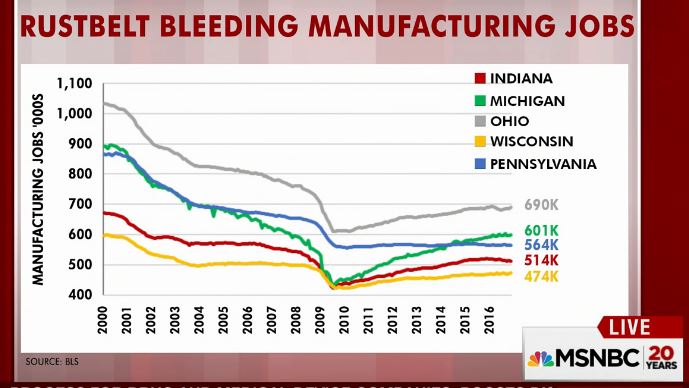
 Every so often on Morning Joe, they have Steve Rattner give the status of some economic condition.  I thought Rattner presented two very compelling charts on the December 1, 2016 show that I have captured related to some of the angry feelings in the Midwest towards government.  Of course one should notice in the figure that the steep decline in Rust Belt manufacturing jobs started well before the Great Recession, mostly during the administration of George W. Bush, with a particularly steep drop ("waterfall") going into the Great Recession.   Such improvement as there has been was during the administration of Barack Obama.  Note that with the Obama administration the decline in manufacturing workforce has stopped and has even started a slow recovery in all the states except Pennsylvania.  You would think that workers would be happy that the decline (the bleeding so to speak) has not only stopped, but actually has slowly reversed in most states.  However, we  are told they aren't happy at all, so the reason for their anger must be sought elsewhere, such as the emotional effects of the Great Recession (see Part 1).  but before we get too hysterical about this, please recall that Trump won these states by very small margins Michigan by less than 11,000 votes out of more than 4.8 million votes cast and Wisconsin by 27,200 out of 2.9 million votes cast and for Pennsylvania won by 46,530 votes out of nearly 6.9 million votes cast.), so maybe many people were grateful for the progress after all.

Below is some of the text of Rattner's presentation (in italics):
(Click on figure to enlarge)

The role that white working class voters played in Trump’s election is now widely accepted; this chart provides graphic back up for how tough it has been for these workers over nearly two decades and how minimal the much vaunted renaissance of manufacturing has been. ...  Pennsylvania, once the home of the steel industry, has had no recovery in manufacturing jobs since the financial crisis.
Only Michigan – thanks to the success of the auto industry – has shown a meaningful rebound in manufacturing jobs and even Michigan’s total is still just two-thirds of what it was at the peak.
It’s important to recognize that not all these job losses are due to trade or globalization; improving efficiency also played a role in the lower need for workers (although those productivity gains have been minimal in the last several years.)*

(Click on figure to enlarge)

Note in the above figure, that although jobs have had a rebound in Michigan, the decline in wages that started long before the Great Recession has continued since, though at a slower pace.  One can see some cause for anger there.  Something like "It is nice to see my friends get back to work, but not at the expense of my wages."

In contrast,  although Pennsylvania has not seen a rise in manufacturing employment, those remaining have seen the largest increase in wages of the five states and actually are even back to 2003 levels.  One might wonder why manufacturing workers in Pennsylvania are so angry as the current workforce has bounced back in wages.

Certainly a part of the problem for the slow wage recovery was lack of a meaningful infrastructure program as construction (among other occupations) was very hard hit by the Great Recession.

Steve Ratner continues:

While attention mostly is focused on jobs, it’s important to recognize that falling wages are also a problem – and nothing in Trump’s announcement will address that problem, which is directly a result of trade and globalization, not automation [Emphasis added.  See comment below]. In this category, Michigan – again because of the strong presence of the auto industry – has been the hardest hit, with average hourly wages in manufacturing falling from $28 per hour in 2003 to just over $20 per hour at present. (These numbers are all adjusted for inflation.)*

Though I have great appreciation for him, Rattner is certainly wrong that automation has had nothing to do with the decline of wages by workers.  The wages actually must be below the costs of automation as well as achieve some sort of parity with the wages of the lowest cost countries.**  Low wages in many countries, however, are tempered by the costs of shipping and some other factors like the generally higher price of natural gas in foreign countries.  Thus the cost of selling something in the US. made in China may be more equivalent to, let's say, $8/hr  (as a guess) rather than the $4/hr cost of labor in China, still a large difference.

I get the feeling that the manufacturing worker has been thrashing around for some years, trying to seek a political solution to the decline in manufacturing in the Rust Belt.  In 2008, these people not only changed the "coach" (the president) but also the "team"  (the Senate and two years earlier the House).  Now in 2016, they changed the coach again, but left the team essentially in place.  We should remember that the President-elect won these Rust Belt states by very small margins, suggestiong to me a high level of confusion.  In the 2016 election they actually chose a n"coach" who was in confilct, not only with most of the Democratic Party but the Republican Party establishment as well but left the "team" essentially in place.  We will see how that works out.


(Click on figure to enlarge)

Adding to their problems is that the American worker has been convinced to disarm and abandon unions.  The decline in wages has paralleled the decline in unions.***   While unions may not be very effective, they are workers only hope in dealing with management.

* http://stevenrattner.com/2016/12/morning-joe-charts-putting-trumps-carrier-deal-in-context/
** http://stopcontinentaldrift.blogspot.com/2014/05/plight-of-american-workers.html
*** http://stopcontinentaldrift.blogspot.com/2013/10/a-race-to-bottom.html

Saturday, March 14, 2015

SCOTT WALKER FOR REPUBLICAN PRESIDENTIAL NOMINEE

Scott Walker, governor of Wisconsin, said what many believe to be a faux paus at the CPAC meeting.  Walker said with regard of groups like ISIS, “If I can take on a 100,000 protesters, I can do the same across the world.”

Though on the face of it the comment is silly, what the critics don't understand is that breaking a union makes a hero of a Republican candidate for president, especially if it is a Civil Service union it seems.  A large part of of Ronald Reagan's stature among Republicans was his breaking of the Air Controller's Union.  In fact the comparison of Walker to Reagan is ongoing now.*

I'm not surprised that Walker is now the leading candidate for the Republican nomination for president, and I wouldn't be surprised if he is successful.  A second notch in his belt is that Wisconsin just became a Right To Work state.  The weird thing is that the so-called disaffected white male worker who votes Republican goes along with this sort of things.  They really think that every man for himself allows them to individually negotiate a good  living.  So as the unions decline so do workers wages.

* http://humanevents.com/2015/03/06/attacks-on-scott-walker-remind-of-reagan/


Saturday, February 26, 2011

THE CASE FOR TEACHERS' UNIONS

The following e-mail is published here with permission:

Dear Friends,

It is time, past time in fact, that I speak my mind about the situation in Wisconsin. I do so from personal experience, an experience which dramatically altered my entire life. Most of you know that my professional background was that as a school teacher and school administrator. I have rarely spoken of the details. They relate directly to the Governor of Wisconsin’s attempt to void the right of collective bargaining for public employees.

I served in the army for 4 years beginning in 1948. It was a great experience for a very young man and quite pleasurable. Because I was a musician I spent my entire 4 year career performing in military bands the last 3 of which was with the 4th Army Headquarter’s Band which was primarily a concert organization. As a percussionist I was able to study all aspects of percussion instruments including the marimba, a mallet instrument much larger than a xylophone, with San Antonio’s Symphony musicians and, as a sidelight, I also studied viola. I had played violin as a child.

Because of the G.I. Bill I was later able to graduate from Northwestern University with a degree in music education. While there I studied many other musical instruments including clarinet, trumpet, oboe, French horn, flute, trombone and cello all from Chicago Symphony musicians. My background in instrumental music was extensive. And, that is what I wanted to teach. I also had a minor in history and just shy of one in English.

I graduated in mid-year after 3 ½ years and desperately needed a job. I was broke. When a position teaching vocal music in Dearborn, Michigan was offered to me I readily accepted with the proviso that when a position in instrumental music became available I would be given high priority.

I worked hard at my job teaching general music, directing operettas and several choruses, but I did not like my job. In fact, I was very unhappy. Four years later, after 2 instrumental positions had been filled with newly graduated teachers, a friend of mine did some research and found that I wasn’t transferred into either of those positions because my school principal liked my work and was unwilling to allow me to transfer. Keep in mind that I had not had a single course in college that qualified me as a vocal music teacher. The state of Michigan said that I was qualified therefore I was certified.

I began researching the job possibilities for me outside education when an acquaintance of mine inquired as to my certification and qualifications. He was about to become the principal in a new junior high school. Ultimately, he offered me a position to teach English and social studies. I accepted. At that time I was working on my master’s degree from the University of Michigan concentrating on economic geography. It was a simple thing to add English courses at his request. I never returned to teaching music.

This entire façade made me angry. How futile and wasteful could it be that one administrator could control the professional lives of qualified teachers not to mention the possible well-being of students? The result. . . I became active in the Dearborn Federation of Teachers. A few years later I left teaching for four years to serve as President of that organization. During that time I had a life-time of experiences with contract enforcement, negotiating, grievance procedures and public relations. Yes, salary and fringe benefits were important, but we had numerous other issues that badly needed change. We needed to give teachers the right to transfer into positions for which they were qualified and certified. We needed to make sure that teachers were teaching in fields for which they were properly certified. We needed to make it possible for women to teach mathematics and science in the high school rather than just holding those positions for men only. We needed to create a salary system that would place women on an equal footing with men. We needed to make it possible for qualified junior high teachers of mathematics to be allowed to teach summer school and night school. Scheduling was difficult and very complex, but we needed to guarantee that all possible steps be taken that would place teachers only in classrooms for which they were qualified. No teacher should teach a class in French, for example, simply because he/she was available at a given time.

Can you imagine the administration demanding these things? Who are you kidding? All of these things would require a lot of extra effort and big scheduling headaches for the administration. It was the teachers’ union that brought those ideas to the table. And, ultimately, we were successful. Now, the governor of Wisconsin wants to go back to a time when the school administration can run the schools in a manner that is most convenient for them. The real concern for the kids comes from the teachers.

Yes, I did spend my last several years in school administration, but it was the Union that taught me what was really important to successful school administration. Destroying their right to collective bargaining would be a terrible mistake. Keep in mind that economic benefits move in several directions. All benefits negotiated by the UAW, for example, went also to all other employees higher up the scale. Only later they would percolate downward to public employees and then, because of profitability for corporations, only a portion would be realized at the public employee level. Even owners of small businesses benefited because a well-paid middle class would serve to enrich those owners.

If the governor of Wisconsin gets his way public education in this country will fall further back. Even with collective bargaining it is difficult to attract highly competent people into educational fields. Without it even more highly competent people will be lost and personal preferences will govern administrative decision-making.

Bill Johnston (e-mail johnston30@nc.rr.com)