Showing posts with label Morning Joe. Show all posts

Monday, December 5, 2016

GREAT RECESSION VERSUS THE GREAT DEPRESSION - II

Part I of the comparison between the Great Recession versus the Great Depression dealt with the emotional after effects of a financial collapse for a country like the U.S.  Herein I will only discuss the economic effects of the Great Recession on labor wages in the Upper Midwest.  This region is often called the Rust Belt, a term that became popular back in the 1980s.  So the labor problems of the Rust Belt have been around for a long time and have little to do with the Great Recession.  Nonetheless, the angry "white" Midwestern workers came to a boil in the recent election.  So why now?

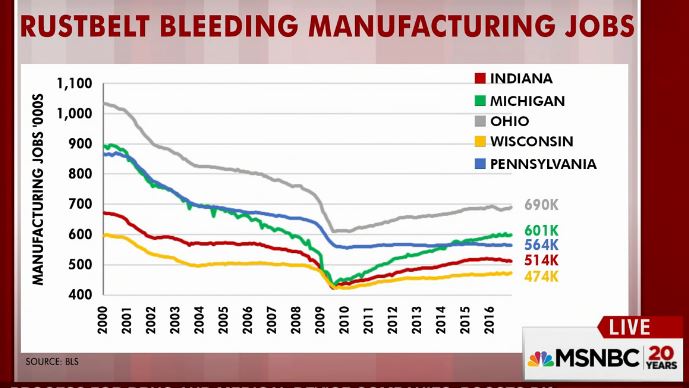
 Every so often on Morning Joe, they have Steve Rattner give the status of some economic condition.  I thought Rattner presented two very compelling charts on the December 1, 2016 show that I have captured related to some of the angry feelings in the Midwest towards government.  Of course one should notice in the figure that the steep decline in Rust Belt manufacturing jobs started well before the Great Recession, mostly during the administration of George W. Bush, with a particularly steep drop ("waterfall") going into the Great Recession.   Such improvement as there has been was during the administration of Barack Obama.  Note that with the Obama administration the decline in manufacturing workforce has stopped and has even started a slow recovery in all the states except Pennsylvania.  You would think that workers would be happy that the decline (the bleeding so to speak) has not only stopped, but actually has slowly reversed in most states.  However, we  are told they aren't happy at all, so the reason for their anger must be sought elsewhere, such as the emotional effects of the Great Recession (see Part 1).  but before we get too hysterical about this, please recall that Trump won these states by very small margins Michigan by less than 11,000 votes out of more than 4.8 million votes cast and Wisconsin by 27,200 out of 2.9 million votes cast and for Pennsylvania won by 46,530 votes out of nearly 6.9 million votes cast.), so maybe many people were grateful for the progress after all.

Below is some of the text of Rattner's presentation (in italics):
(Click on figure to enlarge)

The role that white working class voters played in Trump’s election is now widely accepted; this chart provides graphic back up for how tough it has been for these workers over nearly two decades and how minimal the much vaunted renaissance of manufacturing has been. ...  Pennsylvania, once the home of the steel industry, has had no recovery in manufacturing jobs since the financial crisis.
Only Michigan – thanks to the success of the auto industry – has shown a meaningful rebound in manufacturing jobs and even Michigan’s total is still just two-thirds of what it was at the peak.
It’s important to recognize that not all these job losses are due to trade or globalization; improving efficiency also played a role in the lower need for workers (although those productivity gains have been minimal in the last several years.)*

(Click on figure to enlarge)

Note in the above figure, that although jobs have had a rebound in Michigan, the decline in wages that started long before the Great Recession has continued since, though at a slower pace.  One can see some cause for anger there.  Something like "It is nice to see my friends get back to work, but not at the expense of my wages."

In contrast,  although Pennsylvania has not seen a rise in manufacturing employment, those remaining have seen the largest increase in wages of the five states and actually are even back to 2003 levels.  One might wonder why manufacturing workers in Pennsylvania are so angry as the current workforce has bounced back in wages.

Certainly a part of the problem for the slow wage recovery was lack of a meaningful infrastructure program as construction (among other occupations) was very hard hit by the Great Recession.

Steve Ratner continues:

While attention mostly is focused on jobs, it’s important to recognize that falling wages are also a problem – and nothing in Trump’s announcement will address that problem, which is directly a result of trade and globalization, not automation [Emphasis added.  See comment below]. In this category, Michigan – again because of the strong presence of the auto industry – has been the hardest hit, with average hourly wages in manufacturing falling from $28 per hour in 2003 to just over $20 per hour at present. (These numbers are all adjusted for inflation.)*

Though I have great appreciation for him, Rattner is certainly wrong that automation has had nothing to do with the decline of wages by workers.  The wages actually must be below the costs of automation as well as achieve some sort of parity with the wages of the lowest cost countries.**  Low wages in many countries, however, are tempered by the costs of shipping and some other factors like the generally higher price of natural gas in foreign countries.  Thus the cost of selling something in the US. made in China may be more equivalent to, let's say, $8/hr  (as a guess) rather than the $4/hr cost of labor in China, still a large difference.

I get the feeling that the manufacturing worker has been thrashing around for some years, trying to seek a political solution to the decline in manufacturing in the Rust Belt.  In 2008, these people not only changed the "coach" (the president) but also the "team"  (the Senate and two years earlier the House).  Now in 2016, they changed the coach again, but left the team essentially in place.  We should remember that the President-elect won these Rust Belt states by very small margins, suggestiong to me a high level of confusion.  In the 2016 election they actually chose a n"coach" who was in confilct, not only with most of the Democratic Party but the Republican Party establishment as well but left the "team" essentially in place.  We will see how that works out.


(Click on figure to enlarge)

Adding to their problems is that the American worker has been convinced to disarm and abandon unions.  The decline in wages has paralleled the decline in unions.***   While unions may not be very effective, they are workers only hope in dealing with management.

* http://stevenrattner.com/2016/12/morning-joe-charts-putting-trumps-carrier-deal-in-context/
** http://stopcontinentaldrift.blogspot.com/2014/05/plight-of-american-workers.html
*** http://stopcontinentaldrift.blogspot.com/2013/10/a-race-to-bottom.html

Tuesday, December 1, 2015

CONFESSIONS OF A RECOVERING MORNING JOE ADDICT

I used to watch the 3 hr political morning news show called Morning Joe (Scarborough) since its inception.  I would record it so I could speed through the advertisements.  As the first 20 min. of the program is usually repeated in the third hour, I would also speed through that too.  Sometime in 2015 I got tired of Morning Joe's rants (usually negative) that went on and on and were repeated during and future programs.  As the year went on, I found I was speeding through more and more of the program as they discussed things like Donald Trump ad nauseam..  It finally got so I could race through the 3 hrs in about 1 hr.  The final straw, however, happened when guests on the program started ranting like Morning Joe.  For example, one referred to a TV statement by Sec. John Kerry that he should "shut up" and get some sleep.  Yes, he did look tired and it could have been said so in polite terms rather than the terms used by "red meat" Republicans ("bed wetting" liberals should "Sit Down And Shut Up," they like to say).

So I removed the recording of the program from my VCR about a week ago and have made due with CNN since, though I don't watch it like I used to watch Morning Joe.  It seems there is little new news around so they repeat what little they know about things like the Russian fighter shot down by the Turks, the shooting of the Planned Parenthood building in Colorado, and the shootings of unarmed African Americans (well I guess one had a knife, but he was walking away when shot 16 times).  So I don't record CNN as they seem to report a limited number of events over and over.

Tuesday, February 17, 2015

TRYING TO MAKE THE UNWORKABLE WORK?

Reports today (February 17, 2015) are that polls are showing something like 47% of Americans polled are in favor of boots on the ground in Iraq.*

It has been proposed that the Sunni countries develop a force and get rid of ISIL requiring "boots on the ground."  Respected Richard Haass, president of the Council of Foreign Relations, has been one prominent person to call for such a force.**  Does anyone really believe that the White House wouldn't like such a move?  It is such a great idea that one wonders why the Sunni nations aren't already developing such a force?  One should take into account that even Haass says such a force is a long shot.  Can there be something in the Sunni psyche that we Westerners don't understand?

We need to recall that Turkey has provided a highway for radicals to join ISIL.  There are Saudi's that are said to have provided ISIL with some funds.

Well, for one thing, I wouldn't be surprised if the leaders of the Sunni nation's are sitting around saying to each other, "Cool it, eventually the U.S. won't be able to resist providing cannon fodder (boots on the ground) and mop up ISIL."  I don't know whether Obama will be able to last out his remaining two years with out invading Iraq again with combat troops.

I've heard it said that the Iraq army is really a loose confederation of Shiite militias.  You have to wonder if the Shiites in Iraq are trainable into an army?  After all we already spent 8 yrs before training them and at the first test a whole army did cut and run.  I think a problem is corruption.  I've heard that the leaders of that army were bribed to disappear and that some even joined ISIL  In a country where corruption is so endemic (so I hear), it may be that any government forces are weak even to the point of defending themselves.

This morning I also heard on Morning Joe that the Sunni tribal leaders will not work to overthrow ISIL if Iran is involved, and they seem to be involved in such Iraq forces (militias) that are effective.

Are we trying to make something work that is not workable?  The only way to hold Iraq together seems to be through a brutal dictatorship, a conclusion "we" do not like.  So it seems like it is past time to let Iraq divided into three countries: Sunni, Shiite, and Kurdistan.

* http://www.ibtimes.com/obama-approval-rating-isis-slides-ground-troops-favored-more-americans-poll-1818610
** http://www.ft.com/cms/s/0/8f5ff39a-2c39-11e4-8eda-00144feabdc0.html#axzz3S1dGTZS2 (A second option would be to create a pan-Arab expeditionary force, one with units from Jordan, Saudi Arabia, the United Arab Emirates and possibly Egypt. )

Wednesday, September 24, 2014

I'M SITTING OUT THIS ONE

I've decided I'll sit out the ISIS (ISIL if you prefer) War.  I usually record news programs like Morning Joe so I fast forward through the ISIS parts.  I may miss something else, but so be it.  If the news program is not recorded, I toggle between Soundscapes and the news program to avoid the ISIS War.

I went along with al Qaeda being very bad.  After all they actually killed nearly 3,000 people in this country.  Maybe more if you count those who are delayed in dying from smoke inhalation.  I felt we had to do something and invading Afghanistan to get al Qaeda was fine (remember Afghanistan tribes provided the first "boots on the ground.").  Now we are told that ISIS is even worse.  And the other day I heard of yet another organization that is considered even worse than ISIS in that their aim is to destroy the U.S.(Khorasan).*  And there are also those who say that Hamas is just as bad as ISIS.**

Now during most of my life (and I'm 83) the standard was to say that a group or individual was"worse than the Nazi's."  It is interesting that this analogy is no longer used.  After all, the Nazi's were defeated almost 70 yrs ago.  We've had two or three generations grow up since then.  I guess there is a feeling that ISIS is worse than the Russians.  Remember when it was Assad that had to go?  For the minute we'll ignore him, but I'm sure we'll get back to him some year.

To begin with, we won't put "boots on the ground" though special forces or the CIA don't count.  President Obama wants other Arabs or Muslims to do this.  I have to wonder why they haven't already done this?  They don't seem to worry about ISIS being a threat to them.  We always seem to align ourselves with a group of people that don't want to fight for their land.  Remember Vietnam and the Iraqi military divisions that collapsed when they were first threatened and armed ISIS by abandoning all their equipment?  How many years did we train Iraqi troops - 8 yrs at least, I think.  Who trained the North Koreans (well maybe the Soviets), North Vietnamese, Taliban and ISIS forces?   They seem to be self trained and better than all our training of their opponents    Hey the Americans will do it for us, calm down!

I don't remember the Korean War very well (though I was of age to be called up with the draft), but before we entered the Korean War, it seemed like the North had almost pushed the Southern forces into the sea.**  It used to be that the first thing we would do was send in 5,000 Marines and then regretfully build up from there.  It is interesting, however, that since we were kicked out of Vietnam, they want to be our trading partners, and we have no residual forces there.  Can you imagine that?  And Indonesia is still a non-Communist country.  Remember the Domino Theory where if South Vietnam would fall to the communist North, then the other SE Asian countries would fall, including Indonesia.

Of course the big focus on the Middle East concerns oil.  I had supported oil exploration of ANWR on the north slopes of Alaska and fracking, and the Keystone XL Pipeline to make us independent of  Middle East oil  and allow us to withdraw from there, but it hasn't worked.  Importing some oil from Canada, Mexico, and Valenzuela would be OK.

I yearn for the good old days of Carter and Reagan and Clinton when all we had to worry about were Embassy kidnappings, war with the island nation of Grenada, and fly by shooting of Iraqi radar posts.****  I'm going to sit out this latest war.

* http://www.businessinsider.com/what-is-the-khorasan-group-airstrikes-isis-islamic-state-2014-9
**  http://mondoweiss.net/2014/09/israeli-government-propaganda
***  http://www.history.com/topics/korean-war
**** http://stopcontinentaldrift.blogspot.com/2014/09/good-old-days.html

Monday, September 8, 2014

WHO WILL SUPPLY BOOTS ON THE GROUND?

What a lot of people don't do is review what has happened in Libya.  When we supplied air cover for the the mob there, we had all the ducks in a row.  Everyone was lined up, including the Arab League.  Well the mob won with our help, and we now see that a mob doesn't necessarily result in a going government.  Libya is a mess and as nearly as I can tell the Muslim religious right is gaining ground there.

But ISIS is more complicated than Libya.  We want to get rid of ISIS and so does Iran and presumably dictator Assad of Syria.  Sounds good doesn't it, except we are not really friendly with Iran because we think they want to get THE BOMB.  We also have said that Assad must go.  We must proceed without appearing to support either Iran and Assad.

As for Iraq, we have given air support to the Kurds who have long appeared friendly to us and are willing to fight (and we have also given air support to them before.).  I am less certain about the Shiites, but some of their forces do seem to respond if we supply the air cover.  I assume that a lot of the Sunnis in Iraq are getting fed up with the brutality of ISIS, but their resistance may be half heated unless there is an Iraq government that will share power with them.  We did give some air support for Iraq forces in Anbar Province, a Sunni province.

On Morning Joe this morning, Joe Scarborough indicated that the Arab League seems to have come on board with regards to ISIS.  Obama has also gotten quite a few other countries lined up so I guess he feels he can now proceed.  I had thought that Assad in Syria had seriously depleted the Free Syrian Army that I guess we can support; however, I heard one report of recent Free Syrian Army victories over ISIS.  These poor guys are having to fight on two fronts, but Obama indicates they are the ally of choice to supply the boots on the ground in Syria.  Perhaps if we help arm them and give them air cover they can do better and increase in size but others need to help in both Iraq and Syria.

Monday, August 15, 2011

DEBT CEILING COMPROMISE: EFFECTS

There are two parts to the debt ceiling compromise: (1) is a decrease of about $900 billion in the Federal budget over the next 10 yrs.; (2) is an additional cut in the Federal Budget of $1.1 trillion over the next 10 yrs (I have seen the figure quoted as high a $1.5 trillion) to be decided upon by 12 congressmen over the next six months. In addition, Part 2 has a "poison pill" proviso in it that, if a Super Committee of 12 congress people cannot come to a recommendation of how the $1.1 trillion of cuts can be made, then there is an automatic decrease in the budget of $1.1 trillion with half coming from defense and half from discretionary spending. If the Super Committee can come up with a compromise, then it will be immediately voted on, without amendments, by congress. I can't see these 6 Republicans and 6 Democrats coming to a compromise so I presume that the "poison pill" proviso will occur.

Steven Rattner made an interesting discussion of this on Morning Joe on August 3rd (http://www.msnbc.msn.com/id/3036789//vp/44000516#44000516). Rattner shows a graph in which are shown the increase in the Federal budget before and after the Part 1 of the debt limit compromise. In 2020 he estimates that the Federal Budget would be 25.9% of GDP, whereas the increase in Federal revenues will be only 18.4% of the GDP. Part 1 of the debt limit compromise, however, will reduce the increase of the Federal budget to 24.4% of GDP, lowering the rate of increase in the Federal Budget so it is approximately parallel to the rate of increase of revenues, and thus shows an annual Federal Deficit to $1.5 trillion, presumably in perpetuity.

Rattner did not consider Part 2 of the debt limit compromise because it hasn't been enacted yet, but, if the poison pill is enacted, the projected deficit in the Federal deficit should be in a gradual decline as percent of GDP with a slow convergence to the Federal revenues.

As might be expected, "defense" hawks in congress object to the provision in the "poison pill" that 50% of the cuts come from the DoD and claim it will ruin our security. No doubt this is overstated as they only need to cut $55 billion from a continuous program from a budget in excess of $671 billion for 2012 to come to $550 billion over 10 yrs. The cuts from discretionary spending are a little more severe in a discretionary budget of about $500 billion in that they would have to cut $55 billion from continuous programs to arrive at the $550 billion, their contribution. There are Departments and Administrations with much larger budgets than this. For example the the Presidents proposed discretionary budget for the Department of Education Budget for 2012 is $77,400,391,000 which is reduced to $66,023,391,000 by a decrease in mandatory funding. Though there are those that propose shutting down the Department of Education, it is unlikely to occur. Some other departments with budgets above $55 billion/year are: Agriculture, Health & Human Services, Treasury, Office of Personal Management, and Social Security Administration. I don't suppose that any of these budgets would be totally or significantly reduced. For example in Agriculture, congress hasn't even been able to get themselves to eliminate the corn-based ethanol subsidy, even though the savings in carbon dioxide emission are marginal, and, if you cut down a forest to grow corn, you come out behind.* Not only is the corn based ethanol subsidy marginal in reducing carbon dioxide, but fields converted to corn from other crops help make these other crops more expensive.

Because Step 1 of the Debt Ceiling Compromise only slows the growth of the Federal Budget, I assume it will not push us into a recession,** but , if Step 2 is invoked, the Federal budget will begin to go negative and detract from our GDP (Gross Domestic Product) along with our negative Net Trade Balance. Both Government spending and the Net Trade Balance are in the equation to calculate the GDP. The net Trade Balance deficit right now is around $500 billion a year so would be $5 trillion dollars over 10 years (If the economy improves, it will be greater, and, if we go into a recession, it could be less.). Though it is only a guess, Step 2 might subtract an additional $2 trillion from the GDP over the 10 years. My reasoning is that if $900 billion decreases the rate of increase about in half, another $900 billion should flatten the rate of increase and allow another $200 billion (to make a total of 1.1 trillion) to start decreasing the Federal budget. As the consumer is pretty well tapped out, it will be left to industry to make up for the estimated $7 trillion from the negative Net Trade Balance plus the decrease in the Federal Budget and to push us into a positive GDP. There is no way we can have a positive Net Trade Balance because we refuse to face up to our addiction to foreign oil. Unfortunately, this addiction also leads us to fund our enemies to fight us. I have no idea if companies can more than make up for the negative estimated $7 trillion contribution to GDP from the Net Trade Balance plus the decrease in the Federal spending.

* Note added January 5, 2012. Toward the end of December of 2011, the subsidy was in fact repealed; however, the tariff and percent of gasoline that must be ethanol has not changed and in fact was increased from 10% to 15% by Obama (http://247wallst.com/2011/12/30/us-ethanol-subsidy-is-history-adm-vlo-peix-gpre-czz-rds-a/ & http://www.nytimes.com/2010/10/14/business/energy-environment/14ethanol.html).

**Actually, whether the $900 billion of Part 1 can put us into a recession is complex because the deductions are back loaded, i.e. they will be more in the out years than the near years over the 10 years. I don't know by how much the back loading is. If, say, $500 billion were to be taken out in any one year, it could push us into a recession, but the back loading is probably not that severe. The same applies to Part 2, but is more serious as the Federal budget actually is reduced.