In this comparison of the Great Recession to the Great Depression, a look will be taken at an economic comparison and what, seems to me, to be rather a revisionist examination made in 2014 by Neil Howe in that, while the GDP increased exceptionally well, unemployment remained high.* One similarity is that both these "Greats" were financial collapses that were different from your ordinary recession which are usually due to inventory buildups. Part I concerned the emotional hangover from the Great Depression and Great Recession. Part II concerned the economics of some of the Rust Belt of states prior to and including the Great Recession. The Great Depression did not have a cascade of job losses prior to 1929 that happened prior to the Great Recession (see Part II).
In the figure below, it is seen that the GDP has been slowly increasing since 2009, the depth of the Great Recession. In contrast the dip in the Great Depression that started in 1929 had the GDP of the U.S. rising sharply less than five years after its beginning.
I was born in 1931 so I was only 10 yrs 8 mo. old at the beginning of WW-II and the GDP is shown to be well into positive territory see figure below). Although my memory is limited, my main memory was that you could get a good-sized chocolate candy bar for a nickel and some bars were three for a dime.
The other thing I remember is men coming door to door and asking if they could mow the lawn or do other odd jobs for food. My mother used to give them something but would not invite them inside. I also remember a man coming to the door with a basket full of fine China (made by a German company) having marbleized centers and a gold rim. My mother had also bought some of this same China a few years earlier (I don't know if it was from the same man). So my memory is not conducive to their being good times prior to WW-II and all studies do show unemployment to still be very high by 1939 and 1940 though they differ on the percentage unemployment (9.5% or greater).
In spite of my memories of the late 1930s, GDP bottomed in 1932 - 1933 and began a steep rise. In contrast, the GDP decline was not as great in the Great Recession but bottomed in 2009 and began a relatively slow but steady rise.
(Click on figure to enlarge)
Though the percentage drop in the stock markets were comparable between the two Greats, the recovery of the stock market after the Great Recession has been quite remarkable and much better than for the Great Depression. The figure below shows the comparison for the Dow Jones Industrial Average (The increase has continued beyond the period in the figure and has been repeatedly been setting new all-time highs lately for all four principal indices (DJIA, S&P 500, NASDAQ Composite, and Russell 2000).**
(click on figure to enlarge)
Quoting Mr. Howe, however, suggests a roaring economy for the Great Depression, "GDP grew at a blistering average rate" (though unemployment remained high):
What’s more, from 1933 on, U.S. GDP grew at a blistering average rate of over 8% per year for the next eight years. And that includes one recession year: 1938. By 1941, 12 years after the Great Depression began, U.S. GDP was 41% higher than its pre-downturn figure. This is almost certainly a much higher level, relative to 1929, than the United States will see by 2019, relative to 2007.*
..........................................................
Mr. Howe does conclude that:
These parallels between eras are so numerous and striking that they are
hard to miss once we look broadly at the direction of events. That’s why
connecting the economic challenges of the 1930s with those of the
2010s, and seeing them as comparable in some respects, makes a
difference. When we are connected to history, we can comprehend better
what else is happening in the 2010s, predict better what is likely to
happen next, and to figure out, if necessary, how we can avoid an
outcome that we regard as especially dangerous.
Note On Recessions A list of the Recessions in the U.S. can be seen in Wikipedia including the dates, duration, interval time between recessions, peak unemployment, and GDP decline.** * The GDP decline of the Great Recession is seen to have been only greater during the Great Depression and the "recession" of 1938 (I would say it was a part of the Great Depression) and the recession of 1945 that occurred while industry converted from wartime production back to peacetime. Though the GDP decline in 1945 was larger than for the Great Recession, unemployment in 1945 did not reach the depths of the Great Recession. The only recession worse in unemployment than the Great Recession was that of the long recession of the early 1980s, though the long recession of 1973 - 1975 came close.
* http://www.forbes.com/sites/neilhowe/2014/11/25/are-we-reliving-the-1930s/#57204a703a6c
** https://en.wikipedia.org/wiki/Comparisons_between_the_Great_Recession_and_the_Great_Depression
*** https://en.wikipedia.org/wiki/List_of_recessions_in_the_United_States
https://www.thebalance.com/us-gdp-by-year-3305543
Showing posts with label Great Depression. Show all posts
Friday, December 9, 2016
Monday, December 5, 2016
GREAT RECESSION VERSUS THE GREAT DEPRESSION - II
Part I of the comparison between the Great Recession versus the Great Depression dealt with the emotional after effects of a financial collapse for a country like the U.S. Herein I will only discuss the economic effects of the Great Recession on labor wages in the Upper Midwest. This region is often called the Rust Belt, a term that became popular back in the 1980s. So the labor problems of the Rust Belt have been around for a long time and have little to do with the Great Recession. Nonetheless, the angry "white" Midwestern workers came to a boil in the recent election. So why now?
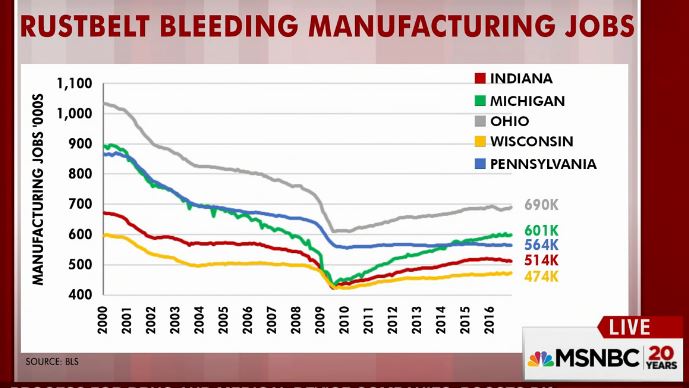
Every so often on Morning Joe, they have Steve Rattner give the status of some economic condition. I thought Rattner presented two very compelling charts on the December 1, 2016 show that I have captured related to some of the angry feelings in the Midwest towards government. Of course one should notice in the figure that the steep decline in Rust Belt manufacturing jobs started well before the Great Recession, mostly during the administration of George W. Bush, with a particularly steep drop ("waterfall") going into the Great Recession. Such improvement as there has been was during the administration of Barack Obama. Note that with the Obama administration the decline in manufacturing workforce has stopped and has even started a slow recovery in all the states except Pennsylvania. You would think that workers would be happy that the decline (the bleeding so to speak) has not only stopped, but actually has slowly reversed in most states. However, we are told they aren't happy at all, so the reason for their anger must be sought elsewhere, such as the emotional effects of the Great Recession (see Part 1). but before we get too hysterical about this, please recall that Trump won these states by very small margins Michigan by less than 11,000 votes out of more than 4.8 million votes cast and Wisconsin by 27,200 out of 2.9 million votes cast and for Pennsylvania won by 46,530 votes out of nearly 6.9 million votes cast.), so maybe many people were grateful for the progress after all.
Below is some of the text of Rattner's presentation (in italics):
(Click on figure to enlarge)
Note in the above figure, that although jobs have had a rebound in Michigan, the decline in wages that started long before the Great Recession has continued since, though at a slower pace. One can see some cause for anger there. Something like "It is nice to see my friends get back to work, but not at the expense of my wages."
In contrast, although Pennsylvania has not seen a rise in manufacturing employment, those remaining have seen the largest increase in wages of the five states and actually are even back to 2003 levels. One might wonder why manufacturing workers in Pennsylvania are so angry as the current workforce has bounced back in wages.
Certainly a part of the problem for the slow wage recovery was lack of a meaningful infrastructure program as construction (among other occupations) was very hard hit by the Great Recession.
Steve Ratner continues:
While attention mostly is focused on jobs, it’s important to recognize that falling wages are also a problem – and nothing in Trump’s announcement will address that problem, which is directly a result of trade and globalization, not automation [Emphasis added. See comment below]. In this category, Michigan – again because of the strong presence of the auto industry – has been the hardest hit, with average hourly wages in manufacturing falling from $28 per hour in 2003 to just over $20 per hour at present. (These numbers are all adjusted for inflation.)*
Though I have great appreciation for him, Rattner is certainly wrong that automation has had nothing to do with the decline of wages by workers. The wages actually must be below the costs of automation as well as achieve some sort of parity with the wages of the lowest cost countries.** Low wages in many countries, however, are tempered by the costs of shipping and some other factors like the generally higher price of natural gas in foreign countries. Thus the cost of selling something in the US. made in China may be more equivalent to, let's say, $8/hr (as a guess) rather than the $4/hr cost of labor in China, still a large difference.
I get the feeling that the manufacturing worker has been thrashing around for some years, trying to seek a political solution to the decline in manufacturing in the Rust Belt. In 2008, these people not only changed the "coach" (the president) but also the "team" (the Senate and two years earlier the House). Now in 2016, they changed the coach again, but left the team essentially in place. We should remember that the President-elect won these Rust Belt states by very small margins, suggestiong to me a high level of confusion. In the 2016 election they actually chose a n"coach" who was in confilct, not only with most of the Democratic Party but the Republican Party establishment as well but left the "team" essentially in place. We will see how that works out.
(Click on figure to enlarge)
Adding to their problems is that the American worker has been convinced to disarm and abandon unions. The decline in wages has paralleled the decline in unions.*** While unions may not be very effective, they are workers only hope in dealing with management.
Every so often on Morning Joe, they have Steve Rattner give the status of some economic condition. I thought Rattner presented two very compelling charts on the December 1, 2016 show that I have captured related to some of the angry feelings in the Midwest towards government. Of course one should notice in the figure that the steep decline in Rust Belt manufacturing jobs started well before the Great Recession, mostly during the administration of George W. Bush, with a particularly steep drop ("waterfall") going into the Great Recession. Such improvement as there has been was during the administration of Barack Obama. Note that with the Obama administration the decline in manufacturing workforce has stopped and has even started a slow recovery in all the states except Pennsylvania. You would think that workers would be happy that the decline (the bleeding so to speak) has not only stopped, but actually has slowly reversed in most states. However, we are told they aren't happy at all, so the reason for their anger must be sought elsewhere, such as the emotional effects of the Great Recession (see Part 1). but before we get too hysterical about this, please recall that Trump won these states by very small margins Michigan by less than 11,000 votes out of more than 4.8 million votes cast and Wisconsin by 27,200 out of 2.9 million votes cast and for Pennsylvania won by 46,530 votes out of nearly 6.9 million votes cast.), so maybe many people were grateful for the progress after all.
Below is some of the text of Rattner's presentation (in italics):
(Click on figure to enlarge)
The role that white working class voters played in Trump’s election is now widely accepted; this chart provides graphic back up for how tough it has been for these workers over nearly two decades and how minimal the much vaunted renaissance of manufacturing has been. ... Pennsylvania, once the home of the steel industry, has had no recovery in manufacturing jobs since the financial crisis.
Only Michigan – thanks to the success of the auto industry – has shown a meaningful rebound in manufacturing jobs and even Michigan’s total is still just two-thirds of what it was at the peak.
It’s important to recognize that not all these job losses are due to trade or globalization; improving efficiency also played a role in the lower need for workers (although those productivity gains have been minimal in the last several years.)*
(Click on figure to enlarge)
Note in the above figure, that although jobs have had a rebound in Michigan, the decline in wages that started long before the Great Recession has continued since, though at a slower pace. One can see some cause for anger there. Something like "It is nice to see my friends get back to work, but not at the expense of my wages."
In contrast, although Pennsylvania has not seen a rise in manufacturing employment, those remaining have seen the largest increase in wages of the five states and actually are even back to 2003 levels. One might wonder why manufacturing workers in Pennsylvania are so angry as the current workforce has bounced back in wages.
Certainly a part of the problem for the slow wage recovery was lack of a meaningful infrastructure program as construction (among other occupations) was very hard hit by the Great Recession.
Steve Ratner continues:
While attention mostly is focused on jobs, it’s important to recognize that falling wages are also a problem – and nothing in Trump’s announcement will address that problem, which is directly a result of trade and globalization, not automation [Emphasis added. See comment below]. In this category, Michigan – again because of the strong presence of the auto industry – has been the hardest hit, with average hourly wages in manufacturing falling from $28 per hour in 2003 to just over $20 per hour at present. (These numbers are all adjusted for inflation.)*
Though I have great appreciation for him, Rattner is certainly wrong that automation has had nothing to do with the decline of wages by workers. The wages actually must be below the costs of automation as well as achieve some sort of parity with the wages of the lowest cost countries.** Low wages in many countries, however, are tempered by the costs of shipping and some other factors like the generally higher price of natural gas in foreign countries. Thus the cost of selling something in the US. made in China may be more equivalent to, let's say, $8/hr (as a guess) rather than the $4/hr cost of labor in China, still a large difference.
I get the feeling that the manufacturing worker has been thrashing around for some years, trying to seek a political solution to the decline in manufacturing in the Rust Belt. In 2008, these people not only changed the "coach" (the president) but also the "team" (the Senate and two years earlier the House). Now in 2016, they changed the coach again, but left the team essentially in place. We should remember that the President-elect won these Rust Belt states by very small margins, suggestiong to me a high level of confusion. In the 2016 election they actually chose a n"coach" who was in confilct, not only with most of the Democratic Party but the Republican Party establishment as well but left the "team" essentially in place. We will see how that works out.
(Click on figure to enlarge)
Adding to their problems is that the American worker has been convinced to disarm and abandon unions. The decline in wages has paralleled the decline in unions.*** While unions may not be very effective, they are workers only hope in dealing with management.
* http://stevenrattner.com/2016/12/morning-joe-charts-putting-trumps-carrier-deal-in-context/
** http://stopcontinentaldrift.blogspot.com/2014/05/plight-of-american-workers.html
*** http://stopcontinentaldrift.blogspot.com/2013/10/a-race-to-bottom.html
Saturday, December 3, 2016
GREAT RECESSION VERSUS THE GREAT DEPRESSION
People will forget what you said. People will forget what you did. But people will never forget how you made them feel.
Attributed to Maya Angelou
Bad times are shaping the temperament of a new rising generation around the world today just as surely as the original Great Depression did back then. http://www.forbes.com/sites/neilhowe/2014/11/25/are-we-reliving-the-1930s/2/#c1e217827916
For America to experience a financial collapse is very dangerous, particularly from the political hangover. In the Great Depression, many people turned to Communism (Soviet style). fortunately this never took root enough to become a reality.
In the Great Recession, people turned to and elected an unqualified candidate who catered to their basest instincts. The consequences of this are still to be determined, good or bad.
"The labor market feels very good," Mark Zandi, chief economist at Moody's Analytics, told CNBC. "Mr. Trump is inheriting a very strong economy. (http://www.cnbc.com/2016/12/02/unemployment-rate-fell-but-a-more-realistic-rate-is-higher.html) The problem is that the people don't feel it and are very angry.
Just how bad was the Great Recession compared to the Great Depression?
For instance, the Dow Jones Industrial Average fell from its pre-recession peak of 14,164 in October 2007 to a low of 6,547 in March 2009. That’s a 54 percent decline in just under a year and a half.*
By comparison, in the 1920s, the decline in stock prices during the first year and a half was more modest -- about 45 percent below the pre-crash peak.
............................................................................
After Lehman Brothers fell, "the transmission of that collapse over to the ‘real economy’ -- soaring layoff rates, reduced hiring, and losses of investor and consumer confidence -- was astonishingly fast," added Gary Burtless, an economist with the Brookings Institution.
....................................................
A big reason for the faster turnaround starting in 2009 is the impact of the economic stimulus bill, "which averted a continuing freefall … even though it was not big enough to bring about a robust recovery," said Robert S. McElvaine, a Millsaps College historian
Also see Wikipedia.**
So while overall the economic effects of the Great Recession were not as bad as the Great Depression because of people's insured bank accounts, the bank rescue, and a small "stimulus program," the political fallout from the Great Recession may be worse because of the election of an unqualified Republican President, and a continuation of the Republican Senate and House. In effect, all the electorate did was change the coach. How much worse, or possibly even better, things will be is yet to be determined, but at least they are given a strong economy to begin with. Let's hope they don't screw it up.
* http://www.politifact.com/truth-o-meter/article/2013/sep/19/comparing-great-recession-and-great-depression/
**https://en.wikipedia.org/wiki/Comparisons_between_the_Great_Recession_and_the_Great_Depression
http://www.forbes.com/sites/neilhowe/2014/11/25/are-we-reliving-the-1930s/#85367b23a6c0
Attributed to Maya Angelou
Bad times are shaping the temperament of a new rising generation around the world today just as surely as the original Great Depression did back then. http://www.forbes.com/sites/neilhowe/2014/11/25/are-we-reliving-the-1930s/2/#c1e217827916
For America to experience a financial collapse is very dangerous, particularly from the political hangover. In the Great Depression, many people turned to Communism (Soviet style). fortunately this never took root enough to become a reality.
In the Great Recession, people turned to and elected an unqualified candidate who catered to their basest instincts. The consequences of this are still to be determined, good or bad.
"The labor market feels very good," Mark Zandi, chief economist at Moody's Analytics, told CNBC. "Mr. Trump is inheriting a very strong economy. (http://www.cnbc.com/2016/12/02/unemployment-rate-fell-but-a-more-realistic-rate-is-higher.html) The problem is that the people don't feel it and are very angry.
Just how bad was the Great Recession compared to the Great Depression?
For instance, the Dow Jones Industrial Average fell from its pre-recession peak of 14,164 in October 2007 to a low of 6,547 in March 2009. That’s a 54 percent decline in just under a year and a half.*
By comparison, in the 1920s, the decline in stock prices during the first year and a half was more modest -- about 45 percent below the pre-crash peak.
............................................................................
Eichengreen and O’Rourke also found the decline in world trade to be steeper, initially, during the 2008-2009 recession.
One of the reasons for the quicker decline in 2008-2009 stems from greater ties between the world’s economies and the refinement of financial technology. Both developments can spread economic problems more quickly and widely.*
On the other hand, the banking collapse in the Great Depression had a much more devastating effect than it did in the Great Recession. You had deposits insured up to $100,000 and the Federal Government bailed out banks in the Great Recession, mainly by finding other banks to take over failing banks.After Lehman Brothers fell, "the transmission of that collapse over to the ‘real economy’ -- soaring layoff rates, reduced hiring, and losses of investor and consumer confidence -- was astonishingly fast," added Gary Burtless, an economist with the Brookings Institution.
....................................................
It took much longer for the Dow Jones to hit bottom in the 1920s -- three and a half years -- but by the time, the total fall was greater. By mid 1932, the Dow had lost 89 percent of its pre-crash value -- a far bigger loss, percentage-wise, than the 54 percent loss after the Great Recession.
Similarly, in mid 2009, both world equity prices and world trade had bottomed out and started heading consistently upward. That’s only about 10 to 15 months. [bolding and underlining added] During the Great Depression, both statistics hit bottom after about 35 months, a period two to three times longer.*
......................................................
In 1929, the annual unemployment rate was 3.2 percent. By 1933, it had peaked at 24.9 percent -- a rise of 21.7 percentage points, or an average of 6.8 percentage points per year.
By contrast, unemployment rose from a low in May 2007 of 4.4 percent to a high of 10.0 percent in October 2009. That’s a rise of 5.6 percentage points, or 2.2 percentage points per year. That’s just one-third of the average annual increase during the Great Depression.
It’s a similar story for gross domestic product. Adjusting for inflation and population, GDP barely suffered a downward blip during the Great Recession, but during the Great Depression, GDP took a whopping eight years to return to its 1929 level.*
.....................................................A big reason for the faster turnaround starting in 2009 is the impact of the economic stimulus bill, "which averted a continuing freefall … even though it was not big enough to bring about a robust recovery," said Robert S. McElvaine, a Millsaps College historian
Also see Wikipedia.**
So while overall the economic effects of the Great Recession were not as bad as the Great Depression because of people's insured bank accounts, the bank rescue, and a small "stimulus program," the political fallout from the Great Recession may be worse because of the election of an unqualified Republican President, and a continuation of the Republican Senate and House. In effect, all the electorate did was change the coach. How much worse, or possibly even better, things will be is yet to be determined, but at least they are given a strong economy to begin with. Let's hope they don't screw it up.
* http://www.politifact.com/truth-o-meter/article/2013/sep/19/comparing-great-recession-and-great-depression/
**https://en.wikipedia.org/wiki/Comparisons_between_the_Great_Recession_and_the_Great_Depression
http://www.forbes.com/sites/neilhowe/2014/11/25/are-we-reliving-the-1930s/#85367b23a6c0
Tuesday, September 6, 2016
WORKERS LAID OFF ARE FINDING WORK
Something that many analysts are not taking into account is that recovery from a near-death financial collapse is different from "ordinary" recessions many of which are inventory overstocking. When the inventories are worked down, then a rapid recovery begins. The only really comparison for the Great Recession is the Great Depression. Compared to this, our recovery is remarkable, and there are those who recognize this:
The latest sign the U.S. labor market is returning to normal, seven years after the recession ended: More workers who lose a job are able to find a new one.
Some 7.4 million people lost jobs between January 2013 and December 2015, including 3.2 million who were laid off from positions they had held at least three years, the Labor Department reported Thursday in its biennial survey of displaced workers. That was down from 2011 through 2013, when 9.5 million people lost jobs including 4.3 million long-tenured workers.
Among the long-tenured workers who were laid off over the past three years, about 66% were re-employed as of January 2016, while 16% were unemployed and 19% had left the workforce. (The figures didn’t add up to precisely 100% due to rounding.)
(click on figure to enlarge.)
http://blogs.wsj.com/economics/2016/08/25/laid-off-american-workers-are-having-better-luck-finding-new-jobs/?mod=djemRTE_h
Wednesday, January 20, 2016
HOW TO GET OUT OF GREAT DEPRESSIONS AND GREAT RECESSIONS
I'm sure you have heard that Roosevelt's policies did not get us out of the Great Depression but that it was WW-II that did it. You hear this especially from Republicans. But it wasn't the war per se that got us out of the Great Depression, it was massive government spending that did it with an assist from forced savings as there wasn't much to buy during WW-II.
So if we wanted to rapidly get out of the Great Recession of 2008-2009 what should we have done. We should have had massive government spending. Yes, Bush's (43) TRAP program to rescue the banks had some deficit spending and Obama's small stimulus fund plus his increased Defense budget helped keep the Great Recession from getting worse, but they weren't big enough to get us out of the Great Recession. In WW-II everyone who had a lath or drill press or spot welder worked for the government war effort. So what was needed was a "war on infrastructure" of at least several trillion dollars. But of course, we can go into massive debt for shooting wars but not for building roads, airports, bridges, and buildings, etc.
Monday, August 22, 2011
MORE
As stated elsewhere, America is a consumerism society (http://stopcontinentaldrift.blogspot.com/2011/07/our-consumerism-society.html). Knowing this , companies do all they can to get us to want ever "more," "more" whatever. But we are well into the new normal of this country where we cannot always want more. We are going to have to decide when enough is enough. When we are happy with what we have and concentrate more on maintaining that. The effect on the economy of the country of not always wanting "more" will be severe. In fact a new economy will have to be invented.
There are people who have decided that we have far too much government. Unfortunately our previous president ruined the economy of the country, and we now have Federal revenues of what they were in 1950 as percent of GDP, though we have twice the population we had then. In the meantime in order to keep the country from sliding into a 1930s style recession, our government spent a lot of money; however, the situation is so dire that our government is running up huge deficits that are making some people very nervous. A recent article suggested that we need to cut the Federal budget by $7.4 trillion over the next decade. If we do this, it will put us into a deep depression at least as bad as in the 1930s.* Think of things we have now that we didn't have in 1950, for example, but with twice the population we will have to go back farther. So one better think of what is enough to make you happy and try to arrange your life to protect that. Even the Debt Ceiling Compromise, if totally enacted, may put us into a recession toward the end of the 10 years: http://stopcontinentaldrift.blogspot.com/2011/08/debt-ceiling-compromise-effects.html
The topic of "more" has been in some movies too. For example take Key Largo. At a point in that movie Humphrey Bogart says to Edward G. Robinson (the crook), "I know what you want." Robinson replies, "Whaaat?" Bogart replies, "You want more. That's what you want." Robinson sort of looks off into space and says, "Yes, yes that's what I want. At least I always have." These are not direct quotes but close enough.
Another is The Treasure of Sierra Madre. The grizzeled old prospector says to his two tenderfeet, "Before we go to search for gold, we have to set a goal for how much we want." The tenderfeet don't like it, but go along. In the end the grizzeled old prospector has none of the gold but is being well taken care of by a tribe of Indians because he saved one of their children. He is happy. One of the tenderfeet who has the gold, Humphrey Bogart, gets captured by benditos who don't know what gold dust is and let it be carried away by the wind while Bogart gets killed. The other tenderfoot leaves the gold to go in search of the wife of a dead prospector and apparently he is happy too. I very much like both of these movies because of their morals.
*Recall that Social Security was in existence then but there was no cost of living increase.
Subscribe to:
Posts (Atom)