So a lady who happens to be African American is pulled over on an open highway because she didn’t signal a lane change in Texas. It is against the law to do so. Well, I think it was a cheap shot, but did the officer just write her a citation and go on his way? No, he demanded that she put out a cigarette (Is smoking in a car against the law?) and yelled at her a number of times to get out of the car. She eventually did this when the officer threatened to “Light you up.” with his taser. She ends up being jailed for three days (!) when she dies from asphyxiation. The claim is that she hung herself with a plastic bag in the jail cell (Why they should have left such a thing in a jail cell, I have no idea). Or maybe they hung her up or something. No matter, the problem is SHE WAS STOPPED FOR AN ILLEGAL LANE CHANGE (NO SIGNAL) ON AN OPEN HIGHWAY, SERVED THREE DAYS IN JAIL, AND ENDS UP DEAD. Dead over an illegal lane change? Unbelievable! May the saints preserve us.
These sorts of things are happening to African Americans all over the U.S. it seems. I'm just counting police here and states involved are Missouri, New York, Ohio, and Texas. Have I missed something? Remember the guy who choked to death from police activity for selling single cigarettes? The boy with the pellet gun who was frantically killed by police?
Thursday, July 23, 2015


Friday, July 17, 2015
MEDICARE/MEDICAID
Republicans don't like health care for the poor. Republicans, along with Democrats and Independents, like Medicare, however

http://www.cnbc.com/2015/07/16/medicare-medicaid-popularity-high-ahead-of-birthday.html

http://www.cnbc.com/2015/07/16/medicare-medicaid-popularity-high-ahead-of-birthday.html
Thursday, July 16, 2015
BUILDER SENTIMENT AT DECADE HIGH
The nation's single-family home builders are feeling a lot
better about their business, even as mortgage rates move higher. A
monthly sentiment index rose to the highest level in July since November
of 2005.*
........................................................
"This month's reading is in line with recent data showing stronger sales in both the new and existing home markets as well as continued job growth," said NAHB Chief Economist David Crowe. "However, builders still face a number of challenges, including shortages of lots and labor."*
Construction was the hardest hit industry during the "Great Recession," but now has labor shortages. We missed a major opportunity to do infrastructure improvements at low cost by not doing them in the "Great Recession."
---------------------------------------------------------------------------------
"There's not a ton of building going on, leverage in the system is reasonable and we still think this economic cycle has a bit of a ways to go," he said. "That's why we're optimistic."**
* http://www.cnbc.com/2015/07/16/builder-sentiment-hits-decade-high-rising-to-60.html
** http://www.cnbc.com/2015/07/15/real-estate-boom-not-over-blackstone-expert-says-at-delivering-alpha.html
........................................................
"This month's reading is in line with recent data showing stronger sales in both the new and existing home markets as well as continued job growth," said NAHB Chief Economist David Crowe. "However, builders still face a number of challenges, including shortages of lots and labor."*
Construction was the hardest hit industry during the "Great Recession," but now has labor shortages. We missed a major opportunity to do infrastructure improvements at low cost by not doing them in the "Great Recession."
---------------------------------------------------------------------------------
U.S. commercial real estate is the midst of a big foreign investment boom that is likely to continue, according to one prominent expert.**
China is leading the boom, but money also is coming from Canada, Norway, the Middle East and elsewhere, Jonathan Gray, global head of real estate at Blackstone, said at the Delivering Alpha conference presented by CNBC and Institutional Investor.**
........................................................."There's not a ton of building going on, leverage in the system is reasonable and we still think this economic cycle has a bit of a ways to go," he said. "That's why we're optimistic."**
* http://www.cnbc.com/2015/07/16/builder-sentiment-hits-decade-high-rising-to-60.html
** http://www.cnbc.com/2015/07/15/real-estate-boom-not-over-blackstone-expert-says-at-delivering-alpha.html
Tuesday, July 14, 2015
WHO WORKS THE MOST AND LEAST?
If you work 40hrs/wk for 52 weeks, you will have worked 2080 hrs for the year. So who works the longest and who works the least in 38 major countries (China not included)?*
Who works the longest? Turns out it is Mexico (2,237 hrs/yr), South Korea (2,i63 hrs/yr), and, surprise, Greece (2.060hrs/yr). A problem with Greece is that only about 52% of the labor force works. In contrast 60.5% of the Mexican labor force works and 61.5% (rank 21 out of 38 major countries) of the South Koreans (rank 7).
Then who works the least? Surprise. In 38th and last place is Germany at 1,362 hrs/yr, followed by Norway at 1,408 hrs/yr and Netherlands at 1,421 hrs/yr. Germany has about 60.3% of the work force occupied (20th place), Norway at 71.2%(!) (3rd place), and Netherlands at 65.2% (10th place). Who beats Norway for work force participation - Sweden at 71.5% (1,607 hrs/yr), and at Number 1 Iceland at 81.4% (1,846 hrs/yr).
The hottest economies were Latvia, Chile and Turkey, all at 4.2% increase in GDP during 2013. Not surprisingly, Greece had the worst economic performance with a 3.9% decline in GDP, followed by Italy at -1.7% and Portugal at -1.6% (because it is mentioned so much,Spain declined by 1.2%).
Well, where was the U.S. in this? We ranked 16th in hours-worked/year (1,788 hrs/yr), 9th in GDP gain at 2.2%, and 13th in work force participation (63.2%).
* http://blogs.wsj.com/economics/2015/07/10/are-americans-working-less-than-the-rest-of-the-world/?mod=djemRTE_h
Who works the longest? Turns out it is Mexico (2,237 hrs/yr), South Korea (2,i63 hrs/yr), and, surprise, Greece (2.060hrs/yr). A problem with Greece is that only about 52% of the labor force works. In contrast 60.5% of the Mexican labor force works and 61.5% (rank 21 out of 38 major countries) of the South Koreans (rank 7).
Then who works the least? Surprise. In 38th and last place is Germany at 1,362 hrs/yr, followed by Norway at 1,408 hrs/yr and Netherlands at 1,421 hrs/yr. Germany has about 60.3% of the work force occupied (20th place), Norway at 71.2%(!) (3rd place), and Netherlands at 65.2% (10th place). Who beats Norway for work force participation - Sweden at 71.5% (1,607 hrs/yr), and at Number 1 Iceland at 81.4% (1,846 hrs/yr).
The hottest economies were Latvia, Chile and Turkey, all at 4.2% increase in GDP during 2013. Not surprisingly, Greece had the worst economic performance with a 3.9% decline in GDP, followed by Italy at -1.7% and Portugal at -1.6% (because it is mentioned so much,Spain declined by 1.2%).
Well, where was the U.S. in this? We ranked 16th in hours-worked/year (1,788 hrs/yr), 9th in GDP gain at 2.2%, and 13th in work force participation (63.2%).
* http://blogs.wsj.com/economics/2015/07/10/are-americans-working-less-than-the-rest-of-the-world/?mod=djemRTE_h
Friday, July 10, 2015
MORTGAGE DELINQUENCIES CONTINUE TO DECLINE
As can be seen from the figure below, delinquent payments on mortgages continue to decline and are at levels last seen in 2008.*

* http://blogs.wsj.com/economics/2015/07/09/the-share-of-americans-behind-on-home-equity-loans-is-the-lowest-since-2008/?mod=djemRTE_h

* http://blogs.wsj.com/economics/2015/07/09/the-share-of-americans-behind-on-home-equity-loans-is-the-lowest-since-2008/?mod=djemRTE_h
Tuesday, July 7, 2015
DEFENSE SPENDING AS PERCENT OF GDP
A recent report shows how much ahead the U.S. is relative to other countries in defense spending as percent of GDP:*
 (Click to Enlarge)
Note that only four countries are spending at least 2% of their GDP on armed forces, the recommended number. They have another figure giving the amount of defense spending for each country in British Pounds that looks even more dramatic.
Of course here in the U.S., there are those who feel that we could never spend enough on defense. One of our problems is that we have our forces spread all over the world and have done so since WW-II. If your goal is to preserve American favorability in trade (imports as well as exports), then you must maintain huge armed forces. And then we "must" continue to develop new and more expense "defense" items in case of another world war.
*
http://www.mirror.co.uk/news/ampp3d/nato-summit-members-not-pulling-4156751

Note that only four countries are spending at least 2% of their GDP on armed forces, the recommended number. They have another figure giving the amount of defense spending for each country in British Pounds that looks even more dramatic.
Of course here in the U.S., there are those who feel that we could never spend enough on defense. One of our problems is that we have our forces spread all over the world and have done so since WW-II. If your goal is to preserve American favorability in trade (imports as well as exports), then you must maintain huge armed forces. And then we "must" continue to develop new and more expense "defense" items in case of another world war.
*
http://www.mirror.co.uk/news/ampp3d/nato-summit-members-not-pulling-4156751
Thursday, July 2, 2015
WORKFORCE PARTICIPATION'S LONG DROP
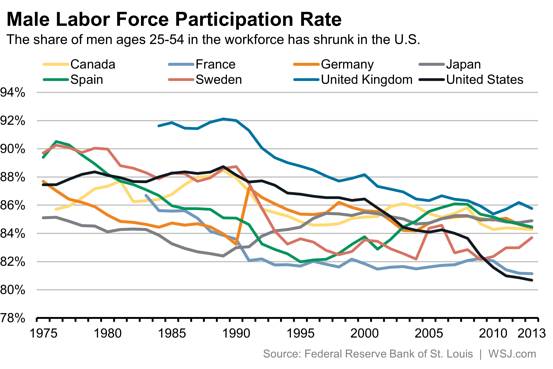
The thing I don't understand about the U.S. drop in workforce participation rate is how are these people living? The men's drop is remarkable and started before 1990. The women are dropping out too, but started later around the year 2000. This drop for women is contrary to all other major countries!* In the second figure, note the spectacular rise in workforce participation rate of women in Japan. The drop of men in Japan's workforce participation rate started in the 1970s, but began to rise again around 1995 and has leveled off in recent years.


* http://blogs.wsj.com/economics/2015/06/26/the-u-s-stands-out-on-labor-force-participation-rates/

* http://blogs.wsj.com/economics/2015/06/26/the-u-s-stands-out-on-labor-force-participation-rates/
Subscribe to:
Posts (Atom)